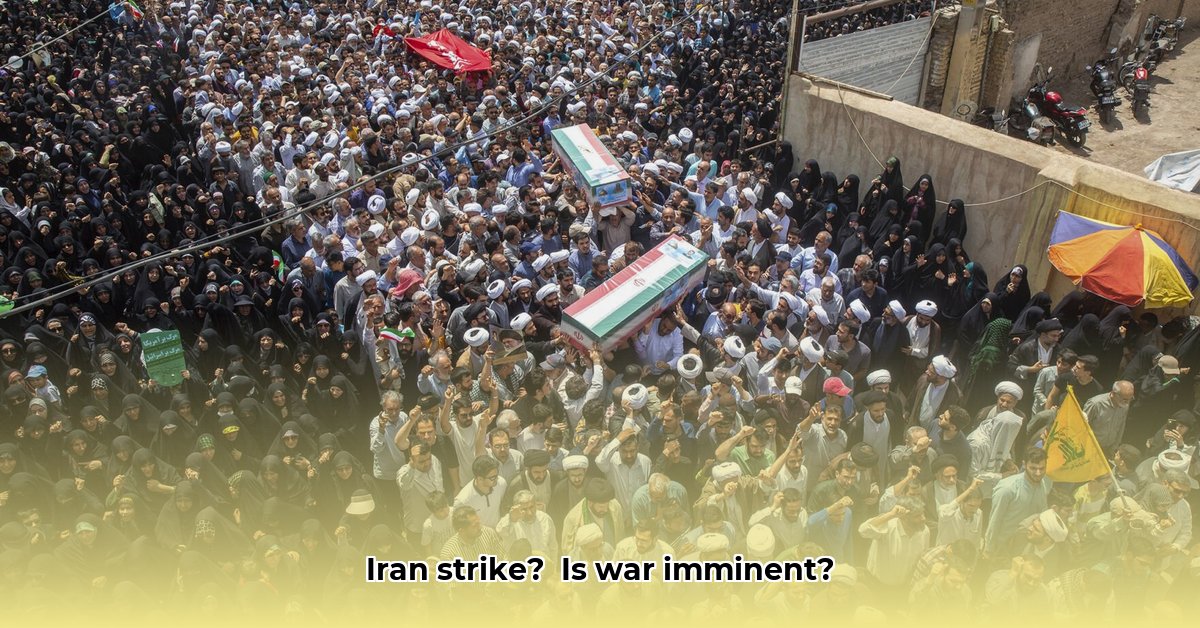
Understanding the Complexities of a Potential Iran Strike
Recent pronouncements by prominent figures regarding potential military action against Iran's nuclear facilities have understandably heightened international tensions. This analysis delves into the multifaceted risks associated with such a strike, examining the potential consequences for regional stability and global security. It's crucial to move beyond the sensationalism often surrounding this issue and engage in a rigorous, data-driven assessment of the potential outcomes.
The notion of a swift, decisive "full-scale obliteration" of Iranian nuclear sites is a significant oversimplification. Iran's nuclear infrastructure is dispersed, fortified, and well-defended, making a successful, comprehensive attack a highly complex and exceptionally challenging military operation. The inherent risk of unintended consequences and escalation is substantial. How likely is a complete destruction of all Iranian nuclear capabilities, and what are the downstream effects?
The Uncertainties and Unintended Consequences of Military Action
A unilateral military strike against Iran's nuclear facilities would almost certainly constitute a violation of international law. Retaliation from Iran and its allies – including potential actors such as Russia, China, and Hezbollah – is highly probable, potentially escalating into a wider regional conflict. The very real possibility of a broader conflict involving major global powers and potentially even employing nuclear weapons necessitates a sobering assessment of risks. This is not a theoretical exercise; the consequences could be catastrophic for the entire region and global security.
Beyond the immediate military response, consider the potential economic upheaval. Disruption to oil supplies and global energy markets would be inevitable, leading to significant economic instability around the world. Are we prepared for such a disruption? How resilient are our global supply chains? Such questions need careful consideration as part of a comprehensive risk assessment.
Key Players and Stakes in the Iran Nuclear Issue
The potential conflict extends far beyond a simple bilateral confrontation between Israel and Iran. The involvement of other significant global and regional actors, including Russia, China, and various Middle Eastern powers, drastically increases the complexity and lethality of the potential conflict. The interconnected nature of global politics means that any military action in this region carries substantial international ramifications.
Furthermore, the role of economic sanctions, cyber warfare, and other non-military forms of pressure cannot be overlooked. These factors must be integrated into a comprehensive analysis to accurately assess the likelihood and impact of various scenarios. What's the actual effect of existing sanctions on Iran's nuclear progress? How might cyberattacks alter the trajectory of events? These questions often remain under-examined in popular media coverage.
Assessing the Risks: A Probabilistic Framework
This risk assessment matrix provides a simplified yet informative overview of the key risks associated with military action against Iran's nuclear facilities:
| Risk Factor | Likelihood | Severity | Mitigation Strategies |
|---|---|---|---|
| Wider Regional Conflict | High | Catastrophic | Enhanced diplomacy, de-escalation initiatives, conflict resolution mechanisms |
| Involvement of External Powers | High | Catastrophic | Clear communication, adherence to international law, proactive engagement with key players |
| Civilian Casualties | High | Catastrophic | Precise targeting, minimizing collateral damage |
| Global Economic Instability | High | Severe | Diversification of energy sources, economic contingency planning |
| Cyberattacks | Moderate | Moderate | Strengthened cybersecurity infrastructure, improved cyber-defense strategies |
This is not an exhaustive list, but it highlights the most critical risks. It is also important to note that the likelihood and severity of these risks are subject to constant change, dependent on evolving geopolitical dynamics and the actions of all involved parties.
Mitigating Risks: A Path Towards De-escalation
The path forward demands a multifaceted approach. Intensified diplomatic efforts, strengthened international cooperation, and a renewed focus on de-escalation strategies are paramount. Rigorous enforcement of existing sanctions and a willingness to explore new frameworks for international cooperation are essential to managing the risks effectively.
Furthermore, a reassessment of traditional deterrence models and the development of adaptive strategies for managing emerging conflict dynamics are necessary. The focus should shift from solely military solutions toward a sustained commitment to regional stability and peaceful conflict resolution.
Professor Anya Petrova, Director of the Centre for International Security Studies at the University of Cape Town, highlights this necessity: "The current situation demands a concerted international effort to avoid escalation. Traditional deterrence strategies may prove insufficient in this complex environment. We need innovative approaches that prioritize dialogue and multilateral cooperation."
The path to de-escalation is challenging, but not impossible. The international community must act decisively to avoid a catastrophic conflict. News updates alone are insufficient for effective risk assessment—rigorous evaluation of probabilities and proactive mitigation strategies are crucial to navigate this critical geopolitical challenge.